





Drone Technology Transforms Clay Tile Roof Inspections
By Brian A. Glover, IT Manager and Drone Pilot
The Game-Changing Solution for Clay Tile Roof Assessment
Picture this: A comprehensive roof inspection completed without a single footstep damaging your valuable clay tiles, without putting inspectors at risk, and at a fraction of traditional costs. This isn’t the future of building inspection—it’s happening right now with advanced drone technology.
Clay tile roofs present unique inspection challenges that have plagued the industry for decades. These beautiful, durable surfaces are notoriously fragile underfoot, making traditional walk-on inspections a risky proposition that often causes more damage than it prevents. Enter drone inspection services: a revolutionary approach that’s transforming how we assess and protect these architectural investments.

Overhead view of the entire clay tile roof (DJI_0126)
Why Clay Tiles Demand Special Attention
Clay tile roofs are engineering marvels, built to last potentially over a century with proper care. But checking them requires careful attention to detail. These roofing systems consist of multiple critical layers: the protective underlayment (featuring base sheets or dual-layer asphalt-impregnated roofing felt), strategically placed metal flashings around penetrations, and the roof tiles themselves—available in an impressive array of sizes, shapes, and profiles ranging from low, medium to high configurations.

Dormer Roof Ridge and exposed metal flashing (DJI_0020)
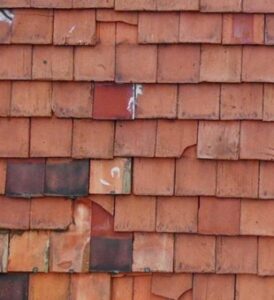
Exposed roof tile clips, cracked and missing roof tiles (DJI_0957)
Understanding these components is crucial because clay tiles employ sophisticated fastening methods that vary based on both substrate and tile type. Traditional ground-level inspections simply can’t capture the full picture of these complex systems.
The Drone Advantage: Precision Meets Innovation
-
- Unparalleled Visual Access Our state-of-the-art drones can hover directly above damaged tiles, revealing critical details invisible from ground level. While a ground inspector might spot an obvious crack or missing tile, our aerial technology can examine whether underlying lapped tiles have sustained damage—intelligence that’s crucial for preventing water infiltration.
- Zero-Contact Assessment Perhaps most importantly, drone inspections eliminate physical contact with delicate clay surfaces. No more risk of creating new damage while assessing existing problems. No more worry about worsening conditions around already compromised areas. It’s pure, non-invasive assessment at its finest.
- Superior Positioning Capabilities: Our drones capture photographs and video footage from virtually any angle, including the optimal perpendicular-to-slope positioning that’s essential for detecting exposed fasteners and assessing the integrity of metal flashing. This maneuverability is particularly valuable when examining roof/wall intersections, valleys, and penetrations where problems typically develop.
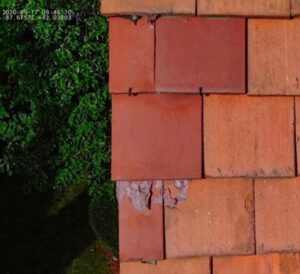
Exposed roof tile hangers and deteriorated roof tile surface (DJI_0012)
Beyond Basic Inspection: Advanced Problem Detection
-
- Mortar Base Coat Analysis The critical mortar base coat that seals tile edges at roof perimeters and ridges requires careful examination. Our drones excel here, following the sloped pathways up and down gabled sections while maintaining the perpendicular angle to roof edges, providing the optimal vantage point for identifying missing or deteriorated base coat that could compromise your entire system.
- Comprehensive Documentation Every flight generates detailed visual documentation that serves multiple purposes: immediate assessment, long-term monitoring, and invaluable records for insurance and maintenance planning.

Mortar base coat at end of Tile Ridge Cap, Adjacent painted wood trim, Clay tile as on a vertical wall (DJI_0098)
The Smart Investment: Measurable Benefits
A drone can’t handle every task, but it’s useful for finding problem areas that need closer inspection and recording areas that look fine from above.
-
- Cost efficient:
- Dramatically reduced inspection time
- Fewer personnel required on-site
- Lower insurance liability costs
- Elimination of potential tile replacement expenses from inspection damage
- Enhanced safety protocol: Complete elimination of fall risks and roof access hazards for inspection personnel, a game-changer for liability management and worker safety compliance.
- Unprecedented accessibility: Steep slopes, difficult access areas, and hazardous roof sections that were previously challenging or impossible to inspect thoroughly are now easily assessable with precision drone technology.
- Future-ready data collection: The imagery and data we collect isn’t just for immediate assessment. It can be seamlessly converted into CAD roof plans, detailed 3D models, or stunning marketing photography for your properties.
- Cost efficient:
Maximizing Your Clay Tile Investment
With ceramic roof tiles carrying 25-year warranties and clay tiles potentially lasting over a century, regular professional inspection isn’t just recommended, it’s essential for maximizing your architectural investment. Drone technology ensures these assessments are thorough, safe, and cost-effective.
The Bottom Line
Drone technology can’t replace every aspect of detailed building assessment, but it does excel at efficiently identifying specific areas requiring additional attention while comprehensively documenting the majority of roof surfaces that are in excellent condition.
Ready to experience the future of building inspection? Raths, Raths & Johnson, Inc.’s (RRJ) advanced drone services deliver superior results while protecting your property investment and ensuring inspector safety. Contact RRJ today to discover how drone technology can revolutionize your next project assessment.